The Cutting Room Floor: Ideas in Progress… or ones that Finally Made It to the Big Time
The documents on this page come straight from the classrooms of the UMBC GIS Program where our ideas hit ground. These working papers, assignment guides, and supporting materials aren’t all polished for journals or wrapped in academic jargon. They’re practical, grounded, and built for impact on regular work and tasks that GIS jockeys and spatial analysts encounter every day. Whether you’re curious about the mechanics of spatial measurement, wrangle geographic data in various programming languages, creating distinguished maps, the internal workings of GIS, or how we integrate GenAI into coursework this is where we share the work as it’s happening… rough edges and all.
Click on a topic for all materials related to a class or theme.

The Data to Ink Ratio with Mapping – An Editor’s Perspective (PDF) offers a critical reflection on how cartographers can improve the effectiveness of their maps by prioritizing the visual display of data over decorative or redundant elements. Drawing from graphic design theory and practical mapping examples, it encourages analysts to evaluate every visual component of a map through the lens of necessity and clarity. The document promotes a disciplined, editor-like mindset when designing maps, where less ink used for non-data elements leads to more powerful and trustworthy visual communication.
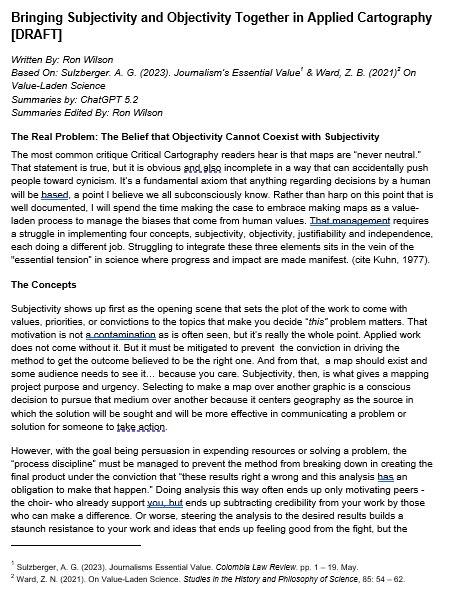
This essay Brining Subjectivity and Objectivity Together in Applied Cartography (PDF) argues that the real fight in applied cartography isn’t between “neutral maps” and “biased maps.” It reframes mapmaking as a deliberate, value-laden craft where subjectivity supplies the motive force while objectivity supplies the evidentiary discipline needed to keep the work credible when stakes are real. The essay adds injects two additional concepts to the discussion that make the whole thing operational, which is through justifiability and independence that reduces the temptation to tune boundaries, classifications, time windows, and uncertainty displays until the map “tells the right story”. The payoff is not purity, but integrity from a documented workflow that persuades beyond the choir, survives scrutiny, and avoids the common oversell failure.

This technical paper The Use and Limits of the Object/Feature ID in Geo-Processing (PDF) explores the technical, often misunderstood role of the ObjectID or FeatureID in GIS software like ArcGIS Pro and QGIS. It explains that these IDs are a system-managed row counters, not a stable feature identifier and not be used for managing data relationships. The document highlights valid use cases, such as when doing a Spatial Join or Near Identification where feature lineage is preserved for traceback. But outside of these narrow cases, though, substantive IDs should be used for joins, summaries, and other mapping tasks. Misuse of the internal IDs can introduce critical errors into data integrity.

This paper, Changing Geographic Units and the Analytical Consequences (PDF), explores how changing the geographic unit of analysis—from census tracts to police divisions—in Charlotte, NC dramatically alters the statistical relationship between residential foreclosure density and violent crime. At the finer tract level, the relationship appears negative, while at the coarser division level it flips to positive, illustrating a classic case of Simpson’s Paradox. The analysis highlights how not using the correct scale misleads pattern interpretations when spatial aggregation masks local variation. The paper serves as a cautionary tale policy makers relying on aggregate data for decision-making without fully considering the modifiable areal unit problem (MAUP) and scale effects.

In The Ground Rent Machine (PDF) by Dr. Dillon Mahmoudi, the paper unpacks how a centuries-old legal structure, a.k.a. ground rent, has contributed to racialized dispossession in Baltimore. Through a detailed spatial analysis of property records, eviction data, and racial demographics, the authors reveal how this mechanism disproportionately burdens Black homeowners, feeding systemic inequality. The study bridges archival research with modern GIS tools to track dispossession spatially, exposing how private profit and public neglect converge. It’s a vivid demonstration of spatial analysis used not just to map problems, but to trace the historical and structural forces behind those problems.